
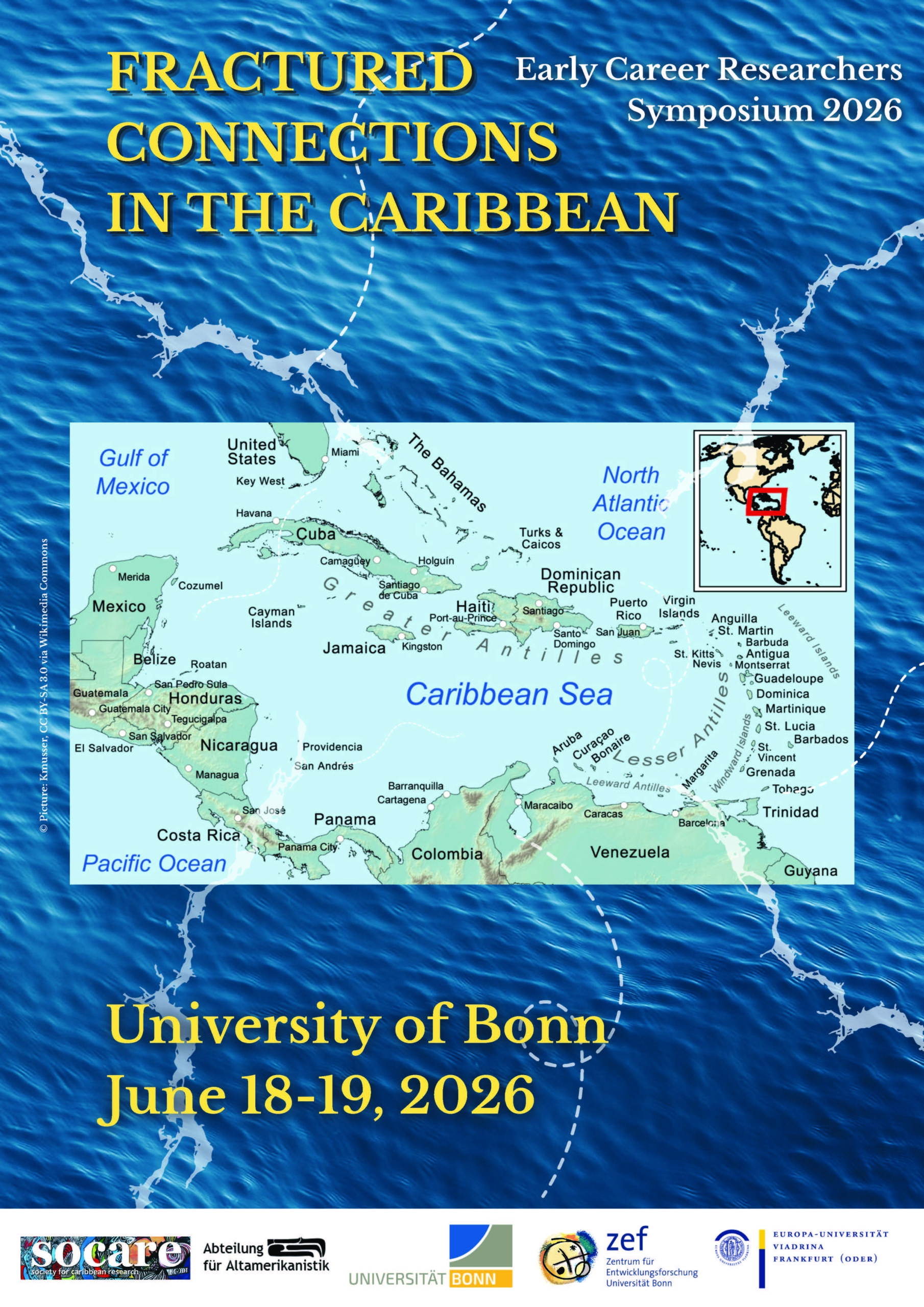
Fractured Connections in the Caribbean
Socare-Early-Career Symposium 2026
Department of Anthropology of the Americas
University of Bonn, 18 – 19 June 2026
Deadline for applications extended until November 15, 2025.
Call for Papers:
Please click here to download the Call for Papers.
Deadline: November 15, 2025
Abstracts (max 300 words) and bionotes (max 100 words) can be sent by November 15, 2025 using the following Google form: https://forms.gle/17eDEiEZuaLC29zz6
In their reflections on and from the Caribbean, Édouard Glissant and Antonio Benítez-Rojo refer to it as a complex space marked by connections, overflowing, ruptures, and shared imaginings (Benítez-Rojo 1986, 1998; Glissant 2010). The Caribbean emerges as a dynamic site where histories, cultures, and languages intersect and diverge in ways that challenge fixed boundaries and linear narratives. Glissant’s notion of the ‘relation’ emphasizes the Caribbean as a place of continual interaction and transformation, where identity is shaped through a web of ongoing cultural exchanges and creolization. Similarly, Benítez-Rojo highlights the ‘repetitive multiplicity’ of Caribbean experience, underscoring how overlapping histories produce both cohesion and fragmentation.
Considering the Caribbean’s multifaceted history and its ongoing tensions and complexities, the planned symposium focuses on the exploration and critical reflection of three modes of relationality: connection, bond, and fracture. These notions serve to form a framework to discuss historical and current events, processes, and phenomena in the Caribbean (both insular and continental). One point of interest will be to analyze how these three elements are conceptualized and approached by researchers, including categorization, identification of nodal points, and methodological proposals. Additionally, we seek to examine how connection, bond, and fracture have shaped the region in various dimensions, such as the production of perceptions and narratives, internal and transoceanic commercial, social, and political dynamics, the configuration of families, and the formation of specific cultural landscapes.
Possible topics for presentations might be, but are not limited to: What methodological and conceptual challenges does it imply to think, discuss, and dimension the creation of bonds, their persistence, and their fractures over time? What role does the linguistic dimension play in the types of relationships that are created and in the fractures that occur in the region? What are the limits and potentials of oral, material, and written records when considering fracture and connection? What impact do migration and diasporic networks have on sustaining bonds across geographical and temporal fractures within Caribbean societies? How do environmental transformations shape experiences of continuity, fracture, and adaptation across Caribbean spaces?
To discuss these questions, we seek perspectives emerging from a broad field of the humanities: e.g., Hispanic studies, French studies, English and American studies, Dutch studies, history, archaeology, anthropology, cultural studies, philosophy, literature, and linguistics. Early-career researchers are invited to submit proposals for a 20-minute paper presentation, followed by a discussion. Abstracts (max 300 words) and bionotes (max 100 words) can be sent by October 30th, 2025, using the following Google form: https://forms.gle/17eDEiEZuaLC29zz6
Organizers:
- Dr. Johana Caterina Mantilla Oliveros (Department of Anthropology of the Americas, University of Bonn).
- Micely Diaz Espaillat (Center for Development Research, University of Bonn).
- Norah El Gammal (Chair of Western European Literatures, European University Viadrina).
Contact:
For any additional inquiries, don´t hesitate to contact us via E-mail: jmantill@uni-bonn.de, micely.diaz@uni-bonn.de, and elgammal@europa-uni.de.